
How to Find Alternative Therapists for Special Needs
Last Updated: October 28, 2026
Quick Summary
An alternative for special needs therapists usually means a different way to find a qualified provider, not a replacement for clinical care. Use directories, state licensing board lookups, and professional registries to locate special needs therapists, then verify credentials, insurance billing, and waitlists before booking. Any creative or sensory approach should complement, not replace, a prescribed treatment plan.
Confirm the provider's license or certification through the state licensing board's public lookup, not their website.
Private speech-language therapy typically costs $100-$250 per session, while art and music therapy run $75-$175.
Ask for the CPT codes the provider will bill and confirm in-network status in writing before the first appointment.
Walk away from any provider promising a cure or asking you to stop a prescribed treatment without the prescriber.
Ask how the provider trains caregivers to carry goals into daily routines, the strongest predictor that gains generalize.
Table of Contents
What 'Alternative' Really Means for Special Needs Therapists
Sensory Tools for Occupational Therapy: What Therapists Actually Recommend
Comparing Therapy Options: CBT, Behavioral Therapy, and Creative Approaches
Sensory Activities for Children with Disabilities: Practical Selection Criteria
Fine Motor Activities for Special Education: Building Dexterity and Coordination
How to Evaluate Evidence and Safety in Alternative Therapies
Exploring Inclusive Sensory Tools for Your Family or Practice
What 'Alternative' Really Means for Special Needs Therapists
Search for an Especial Needs alternative for therapists and you'll find two very different things sharing one phrase. One is a substitute for a specific provider directory: families looking for another way to find a qualified special needs therapist when a familiar listing site comes up short. The other is a substitute for therapy itself: a creative or sensory approach used instead of, or alongside, established clinical care. Confusing the two wastes time and, in the worst cases, delays real support.
We'll define what "alternative" should mean for special needs therapists, compare therapy options by suitability and evidence, and give you practical criteria for choosing a provider. Here's the throughline: an alternative is only useful when you can name what it replaces and how you'll measure whether it worked.
**** That definition matters because it sets the boundary. A directory alternative changes how you find that professional. A therapy alternative changes what the professional does, or replaces them entirely. Only the first is a safe default.
Sensory Tools for Occupational Therapy: What Therapists Actually Recommend

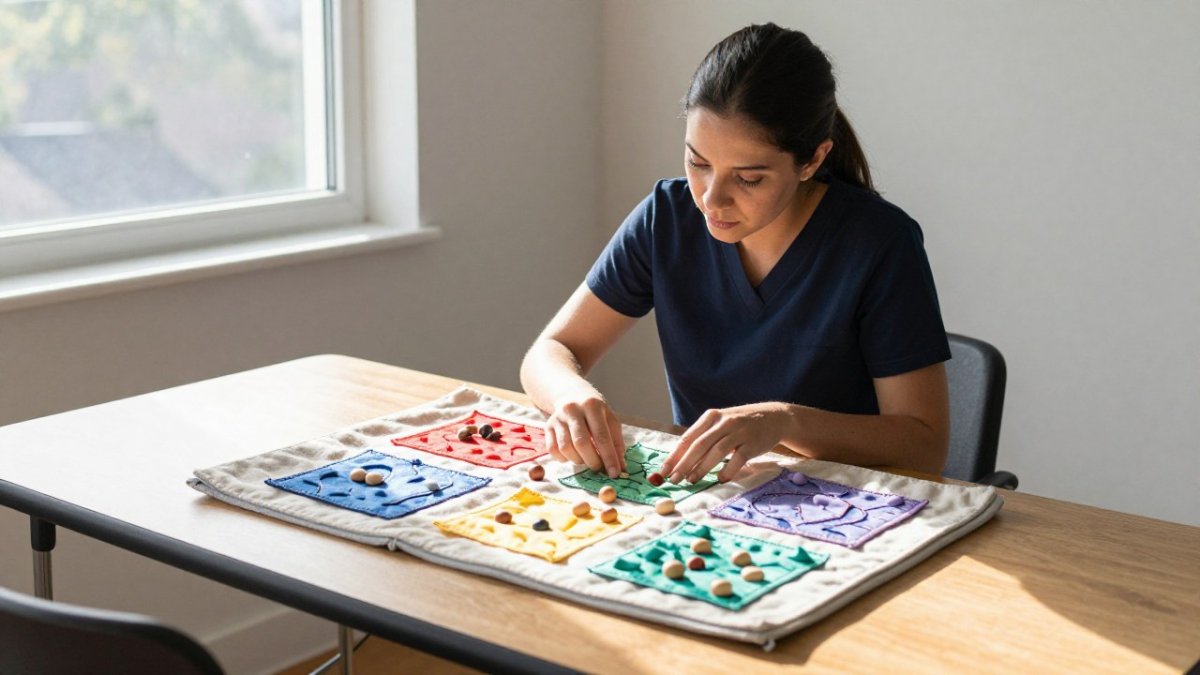
A common mistake is buying a tool for one narrow purpose. A textured fidget helps with tactile input, but a well-made fabric game with buttons, shapes, and pockets can serve sensory integration, fine motor practice, and social turn-taking in the same session. That versatility is what most clinic shelves actually reward. For a deeper look at the tools practitioners reach for, see our guide to sensory tools for occupational therapy practice.
Comparing Therapy Options: CBT, Behavioral Therapy, and Creative Approaches
Therapy options for children with disabilities and developmental differences fall into a few broad families, and each fits a different need. But a table of modalities is not what most families and therapists actually need, they need to know which option fits which person, at which age, through which access channel, and at what cost. That is the comparison this section makes.
Approach | Best For | Typical Setting | Who Delivers It | Access and Cost Notes | Evidence Base |
CBT | Anxiety, stress, emotional regulation, depression | Outpatient clinic, school-based, teletherapy | Licensed psychologist, LCSW, LPC | Often covered by commercial insurance; sliding scale common at community clinics | Strong for many conditions |
Behavioral therapy (ABA and related) | Skill-building, behavioral needs, daily living | Clinic, home programs, school | BCBA, RBT under supervision | Coverage varies widely by state and plan; waitlists are common | Strong, widely used |
Speech-language therapy | Communication, feeding, social communication | Clinic, school, teletherapy | SLP (CCC-SLP) | School-based services free through IEP; private pay $100-$250/session typical | Strong |
Occupational therapy | Sensory integration, fine motor, daily living | Clinic, school, home | OTR/L | School-based through IEP; private often insurance-covered with diagnosis | Strong |
Physical therapy | Mobility, gross motor, strength | Clinic, school, home | DPT | Insurance-covered with referral; school-based through IEP | Strong |
Art and creative therapies | Expression, coping, engagement | Individual or group | Board-certified art therapist (ATR-BC) or music therapist (MT-BC) | Rarely insurance-covered; $75-$175/session private pay typical | Growing, varies by use |
Equine-assisted and wilderness therapy | Confidence, participation, movement | Specialized programs | Certified equine therapist or program staff | Almost always private pay; $100-$300/session typical | Mixed, program-dependent |
Pro Tip Ask any provider two questions before booking: "Which license or certification do you hold, and which state board issued it?" and "Do you bill insurance directly, or will I pay out of pocket and submit for reimbursement?" The answers sort options faster than any modality description.
Sensory Activities for Children with Disabilities: Practical Selection Criteria
Input type: Does it offer tactile, proprioceptive, or visual feedback the child actually seeks?
Regulation goal: Is it calming or alerting? Pick based on the moment, not the toy's marketing. For children with sensory processing disorder, see these calming activities for sensory processing disorder.
Adaptability: Can it be used by a three-year-old and an older sibling without modification?
Safety: Look for child safety certification and materials that hold up to mouthing and washing.
Durability: Soft fabric and reinforced stitching outlast brittle plastic in daily use.
Fine Motor Activities for Special Education: Building Dexterity and Coordination
Teachers and therapists often pair these with a tactile game that requires fingers to work while conversation happens, which builds coordination and social skills together. For product-level recommendations, our sensory toys for fine motor development guide covers options by skill. Parents working at home will find a step-by-step approach in our parent's guide to improving fine motor skills.
Cost, Insurance, and Access: Navigating Therapy Services
A practical approach: confirm coverage in writing, ask about sliding-scale options, and check whether your state's early intervention program applies. The Center for Parent Information and Resources maintains family-facing explanations of special education rights and service access that are worth reading before any intake call.
How to Evaluate Evidence and Safety in Alternative Therapies
Provider-selection checklist
Disability competence: Ask how many clients with your specific diagnosis or need the provider has worked with in the past year, and whether they have training in that area (for example, autism-specific training, AAC, or sensory integration).
Credentials: Confirm the license or certification and verify it through the state licensing board's public lookup, not the provider's website. For behavior analysts, check the Behavior Analyst Certification Board registry; for speech-language pathologists, check the American Speech-Language-Hearing Association directory.
Accessibility: Ask about wheelchair access, quiet waiting areas, sensory-friendly scheduling, interpreter availability, and whether sessions can be conducted at home or via teletherapy.
Communication preferences: Confirm how progress is shared (written reports, portal messages, phone calls) and how often, and whether caregivers are included in sessions.
Insurance and cost: Get the CPT codes the provider will bill, confirm in-network status in writing, and ask about sliding-scale slots and payment plans before the first appointment.
Location and waitlist: Ask the current waitlist length and whether the provider offers teletherapy across state lines (licensure rules vary by state).
Caregiver involvement: Ask how the provider trains caregivers to carry goals into daily routines, the single strongest predictor of whether gains generalize.
Red flags to walk away from
A promise of a cure, or a claim that the approach works for every diagnosis.
A request to stop a prescribed medication or treatment plan without consulting the prescriber.
No written treatment plan, no measurable goals, and no scheduled progress review.
Pressure to prepay for a large package before any assessment.
Unwillingness to coordinate with the child's school team, pediatrician, or other therapists.
The National Center for Complementary and Integrative Health publishes plain-language guidance on what evidence exists for many complementary approaches, which helps separate promising options from unproven ones. The Center for Parent Information and Resources explains special education rights and how to request evaluations through the school system. Safety comes first: no alternative should replace emergency care or a prescribed treatment plan without a clinician's involvement.
Exploring Inclusive Sensory Tools for Your Family or Practice
Witzkan builds handcrafted sensory-tactile games sewn from soft American flannel in Saegertown, Pennsylvania, and US child safety certified. They're designed for inclusive play from ages three to 103, so a seven-year-old and a grandmother can genuinely use the same game. You can browse all products to see the full catalog of inclusive sensory tools.
Frequently Asked Questions
What can therapists use instead of traditional therapy activities?
Therapists often swap worksheets and drills for hands-on sensory tools that keep clients engaged. Soft tactile games, textured fabrics, and manipulative toys support fine motor skills and coordination while feeling like play. For children with sensory sensitivities, these tools provide calming input that helps regulation during sessions. Witzkan's handcrafted flannel games are one option designed for inclusive use across ages and ability levels, and they can be incorporated into occupational therapy or special education settings alongside a therapist's existing plan.
How can sensory tools support fine motor skills and coordination?
Sensory tools that require grasping, pinching, sorting, or manipulating small pieces give hands repeated practice with graded movements. Soft flannel textures add tactile feedback that helps children with developmental differences build finger dexterity without the frustration of harder materials. Coordination improves as kids match colors, shapes, and names while using both hands together. These fine motor activities for special education can be adapted for different skill levels, making them useful for classrooms, therapy sessions, and home practice between appointments.
Can sensory games be used alongside occupational therapy?
Yes. Many occupational therapists recommend sensory activities for children with disabilities as home carryover between sessions. A tactile game that encourages memory, coordination, and conversation can reinforce goals set during therapy. Ask your child's therapist which specific skills to practice and how often. Witzkan's multi-sensory design supports colors, shapes, and naming, so it aligns with common early-learning goals. Keep the game accessible and low-pressure so the child sees it as play, not homework.
How do I choose an alternative therapist for my child with special needs?
Start by clarifying what 'alternative' means for your family: a different therapy modality, a private provider outside school services, or a complementary approach used alongside standard care. Check credentials, ask about experience with autism and developmental differences, and confirm whether the provider accepts your insurance. Request a short consultation to discuss goals, measurement of progress, and safety. Practical provider-selection criteria include licensing, communication style, availability, and whether the therapist collaborates with your child's school team and other providers.
Finding the right support for a child with sensory or developmental needs takes patience, and the tools you choose should earn their place in daily routines. Witzkan makes handcrafted sensory-tactile games from soft American flannel, US child safety certified and designed for inclusive play across ages. Explore our designs and give your family or practice a tool that builds dexterity, coordination, and connection at the same time.


Comments