
Tactile Games for Memory Recall: A Practical Guide
Table of Contents
Why Touch Beats Screens for Memory Recall
How Tactile Memory Games Work
How to Make a Tactile Memory Game at Home
Materials That Hold Up to Daily Play
Step-by-Step Assembly
Tactile Memory Games for Children with Visual Impairments
Fine Motor Activities for Children That Pair With Memory Play
Matching Games to Ages and Abilities
Common Mistakes That Undercut Memory Play
Frequently Asked Questions
Last Updated: October 21, 2026
Why Touch Beats Screens for Memory Recall
Tactile games for memory recall work because touch gives the brain more to hold onto than a screen ever can, and that is exactly why we design tactile games for memory recall around real materials. A tile has weight, texture, and temperature. A swipe has none of that. When a child or an older adult handles a physical piece, the brain files that memory under several labels at once: what it felt like, what it looked like, and what it was called.
That is the core idea behind every tactile memory game we make at Witzkan. Multi-sensory input gives recall more pathways to travel. Screens are fast, but speed is not the same as sticking.
Touch adds texture, weight, and shape to every memory
Physical pieces slow play down, which helps encoding
Handling objects builds finger strength at the same time
No notifications, no glare, no charge cable
The American Academy of Pediatrics guidance on screen time notes that hands-on play supports healthy development in ways passive media does not. That lines up with what we hear from parents and therapists.
How Tactile Memory Games Work
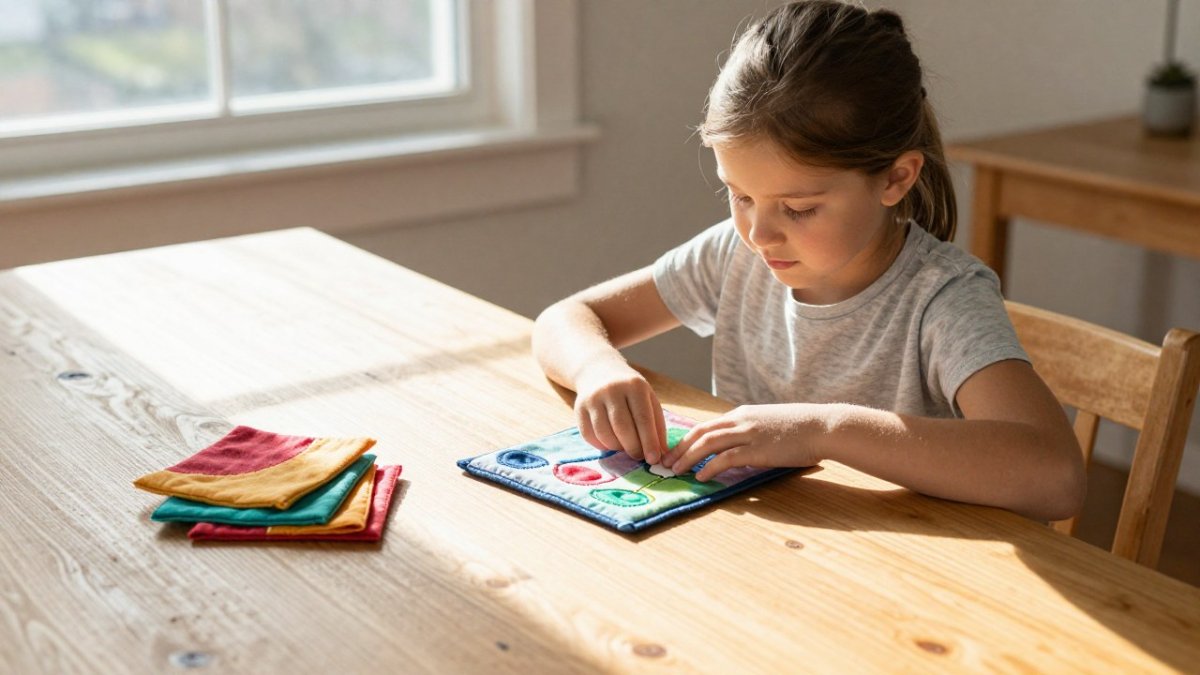
A tactile memory game is any matching or recall activity where players identify pieces by touch rather than sight alone. The classic version is a face-down matching pair game. The tactile version adds texture, shape, or stitching to the back of each piece so fingers can sort them.
Here is what happens during play:
Encoding: the player feels a piece and links its texture to its picture or name
Retention: the piece is hidden, forcing the brain to store the link
Recall: the player finds the match using touch, sight, or both
Reinforcement: each successful match strengthens the link
Memory recall is the process of pulling stored information back into mind, and touch gives that process extra handles. A rough corduroy square feels different from a smooth flannel circle. The brain tags each one separately, so recall has more to grab.
Pro Tip Flip the pieces face down and let the player feel the backs before turning any over. That one step turns a simple matching game into a true tactile memory exercise.
How to Make a Tactile Memory Game at Home
You can build a working tactile memory game in about an hour with basic craft supplies. The key is matching textures in pairs so players can sort by touch.

Materials That Hold Up to Daily Play
Cheap materials fall apart fast, and a game that sheds pieces is a choking risk. Choose sturdy options:
Heavy cardstock or thin cardboard for the base
Felt, flannel, corduroy, and burlap scraps for texture
Fabric glue or a hot glue gun with adult supervision
Scissors, a ruler, and a marker
Clear contact paper to seal the edges
Step-by-Step Assembly
Cut 12 to 20 squares of equal size from your cardboard.
Cut two matching texture patches for each pair.
Glue one patch to the back of each card, keeping pairs identical.
Add a picture or sticker to the front if you want a sight-matching option.
Seal the edges with contact paper so corners do not peel.
Let everything dry flat overnight before play.
Watch Out Skip the seal and the fabric edges will fray within weeks. Loose threads end up in mouths and on floors, and the game loses its matching pairs.
Tactile Memory Games for Children with Visual Impairments
Tactile memory games for children with visual impairments remove sight from the equation entirely. Every piece carries its identity in texture, shape, or a raised mark. Players sort, match, and recall by hand alone.
A few design rules make the difference:
Use strongly contrasting textures, not subtle ones
Keep one texture per pair so fingers can tell them apart
Add raised shapes or braille labels for naming practice
Keep pieces large enough to grip easily
Store pieces in a divided tray so sorting is part of the game
The National Federation of the Blind resources on tactile learning stresses that touch-based materials should be durable and consistently textured. Inconsistent materials confuse the hand, and confusion kills recall.
Our flannel games follow the same logic. Soft American flannel gives a clear, repeatable feel that small hands can learn to recognize.
Fine Motor Activities for Children That Pair With Memory Play
Fine motor activities for children pair naturally with memory games because both depend on the same hand muscles. Pinching, sorting, and turning small pieces builds dexterity while the memory work happens.
Try these pairings:
Pinch and place: move pieces one at a time with thumb and index finger
Texture sort: separate pieces into piles by feel before matching
Stack and recall: build a short stack, hide it, then rebuild from memory
Button and snap practice: add fasteners to pieces for grip work
Tray transfer: move pieces between trays with a spoon or tongs
Each activity works the small muscles in the fingers and hands. Combine them with matching play and you get two benefits from one session.
Matching Games to Ages and Abilities
Different ages need different levels of challenge. A game that frustrates a three-year-old will bore a ten-year-old, so match the difficulty to the player.
Age or Ability | Pieces | Rules | Best For |
Ages 3-4 | 6 to 8 | Face up, match by sight | First matching skills |
Ages 5-7 | 10 to 12 | Face down, match by sight | Classic memory play |
Ages 8+ | 16 to 20 | Face down, match by touch | Advanced recall |
Visual impairment | 8 to 12 | Touch only, raised marks | Independent play |
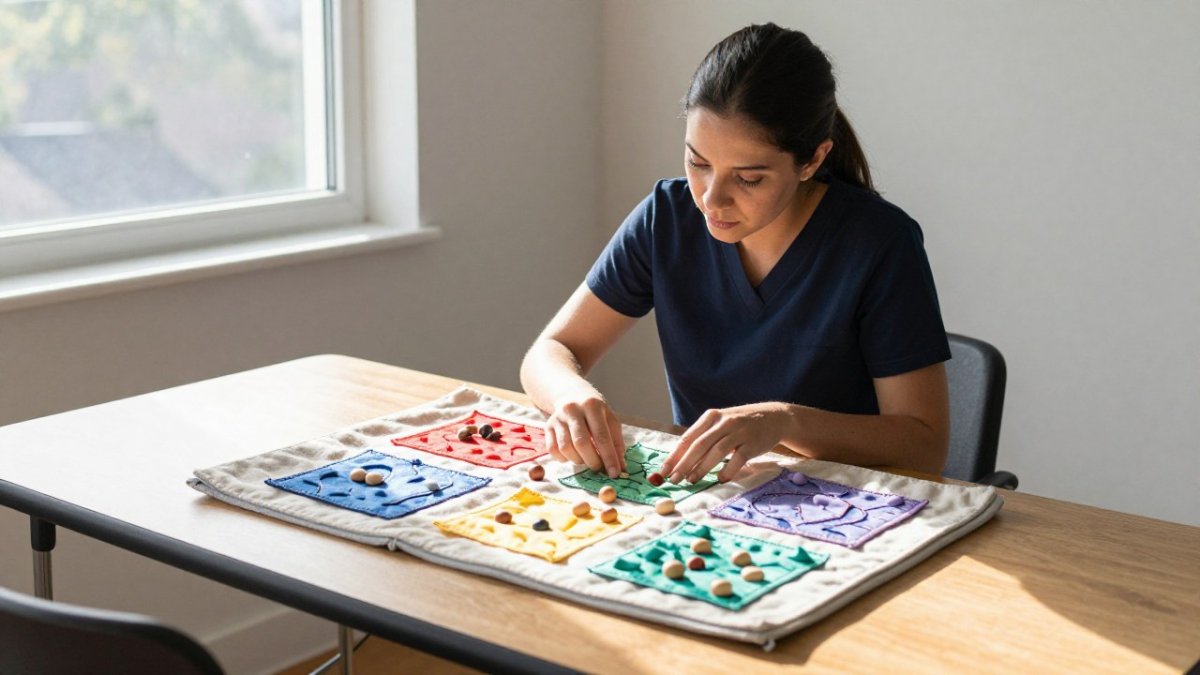
Older adults | 12 to 16 | Face down, gentle pace | Cognitive maintenance |
Start easy and add pieces as confidence grows. The right challenge level keeps players coming back.
Key Takeaway The best tactile memory game is the one the player can almost solve. Too easy and it gets boring. Too hard and it gets abandoned.
Common Mistakes That Undercut Memory Play
Most memory play fails for avoidable reasons.
Too many pieces at once. Start small and build up. A pile of 30 pieces overwhelms beginners.
Subtle textures. If two textures feel nearly the same, the game stops working. Contrast matters.
Skipping the naming step. Say the color, shape, or object out loud. Words strengthen the memory.
Rushing the recall. Give players time to think. Speed is not the goal.
Ignoring wear. Check pieces for loose edges and fraying. Worn pieces confuse touch-based players.
Playing only one way. Rotate between sight, touch, and naming versions to keep interest high.
One more mistake worth naming: treating the game as a test. It is play. Pressure shuts down recall, and a stressed player remembers less, not more.
At Witzkan, we build our games to survive daily play. Each one is handcrafted in Saegertown, Pennsylvania from soft American flannel, and each carries US child safety certification. The inclusive design works for ages three to 103, so one game can serve a whole family or a therapy caseload.
The U.S. Consumer Product Safety Commission toy safety guidance explains what certified toys must pass. Ask any maker for their certification details before you buy.
Frequently Asked Questions
What is a tactile memory game?
A tactile memory game is a matching activity where players identify pairs by touch rather than sight. Cards or pouches hold different textures, such as flannel, corduroy, sandpaper, or felt, and players feel for matching pairs without looking. Because touch sends detailed signals to the brain, these games exercise short-term recall in a way screens cannot. They work for sighted players and for children or adults with visual impairments, and they double as fine motor practice because fingers do the identifying.
How can touch-based games help with memory recall?
Feeling a texture forces the brain to hold that sensation in working memory while the hand moves to the next piece. That hold-and-compare loop is the same skill used in any memory task, just routed through touch instead of sight. Repeated play strengthens short-term recall and texture discrimination. The effect comes from repetition and attention, so short daily rounds beat one long session per week.
Are tactile memory games suitable for children with visual impairments?
Yes, and they are often a better fit than standard picture-matching games. A tactile memory game for children with visual impairments relies on distinct textures rather than images, so a child can play independently or alongside sighted peers. Keep textures clearly different from one another, such as smooth satin versus rough burlap, and place a small tactile marker on the back of each card so orientation is easy to check by hand. Adult supervision is still needed for children under three because small pieces pose a choking risk.
How do you adapt a tactile memory game for different ages and abilities?
Start with four to six pairs for preschoolers and add pairs as recall improves. For seniors or players with cognitive changes, use fewer pairs and larger, easy-to-grip pieces. For players with limited hand strength, choose soft flannel or foam over stiff cardboard. You can also add a naming step, where players say the texture out loud, to bring language into the game. A well-made set sewn from soft flannel suits a wide age range, which is why one game can serve a 7-year-old and an 82-year-old at the same table.
Memory play only works when the pieces hold up and the challenge fits the player. That is the gap we built Witzkan to fill. Our handcrafted flannel games are sewn for daily use, safety certified, and designed for shared play across generations. They boost memory, coordination, and finger dexterity while giving players a calm, screen-free way to connect. Explore our designs and find the set that fits your family, classroom, or therapy practice.
Explore Our Designs

Comments